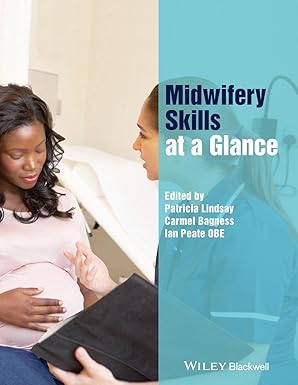
พิมพลักษณ์ : Hoboken, NJ : John Wiley, c2018
บทคัดย่อ : Being an effective midwife requires a range of knowledge and skills, all of which are essential to provide competent and safe care to childbearing women and their infants. Midwifery Skills at a Glance offers an invaluable, straightforward guide for students and practitioners – offering readable, easily digestible information, supported with illustrations throughout to enhance application to practice. Clear and concise throughout, Midwifery Skills at a Glance covers a wide range of skills – exploring issues such as infection control, personal hygiene care, and safeguarding; assessment, examination and screening skills; how to care for the woman and neonate with complex needs; drug administration and pain relief.
หมายเหตุสารบัญ : Note continued: 20.'Booking': the initial consultation with the midwife -- 21. The antenatal appointment: physical and psychological assessment of the woman in pregnancy -- 22. Abdominal examination in pregnancy -- 23. Physical and emotional assessment after birth -- Care of the woman in labour -- 24. Assessing the woman in labour -- 25. Abdominal examination in labour -- 28. Vaginal examinations in labour -- 27. Positions in labour and birth -- 28. Supporting and caring for women in labour -- 28. Supporting and caring for the partner -- 30. Care of the perineum in labour including episiotomy and suturing -- 31. Examination of the placenta and membranes -- 32. Urinary catheterisation -- The fetus in pregnancy and labour -- 33. Assessing fetal wellbeing in pregnancy and labour -- 34. Monitoring the fetal heart in pregnancy and labour -- Assessment and examination of the neonate -- 35. The Apgar score. 36. The midwife's examination of the baby at birth including identification of the neonate -- 37. Appearance and characteristics of the well term neonate -- 38. Overall daily assessment of the term neonate including vital signs and bladder and bowel function -- 38. Newborn and infant physical examination -- 40. The term, preterm and growth-restricted baby -- Caring for the newborn -- 41. Providing daily hygiene for the neonate including changing a nappy -- 42. Bathing the newborn -- 43. Breastfeeding -- 44. Formula feeding -- 45. Other feeding methods -- 46. Neonatal blood screening ('heel prick') -- Blood sampling and cannulation -- 47. Maternal venepuncture, including glucose tolerance testing -- 48. Cord blood and neonatal capillary blood sampling -- 48. Venous cannulation of the woman -- Taking and testing other body samples -- 50. Urinalysis -- 51. Specimen collection -- stool specimen -- 52. Taking a wound swab. 53. Use of a vaginal speculum and taking a vaginal swab -- Induction/stimulation of labour -- 54. Membrane sweep -- 55. Insertion of vaginal prostaglandin E2 -- 58. Artificial rupture of membranes -- Care skills for the woman with complex needs -- 57. Recognising the deteriorating woman -- 58. CVP, Spot and ECGs -- 58. Fluid balance monitoring -- 60. Peak flow measurement in the woman -- 61. MEOWS, AVPU, GCS and SBAR -- 62. Care of the deceased -- Care skills for the baby with complex needs -- 83. Recognising deterioration in the neonate -- 84. Neonatal jaundice -- 65. Hypoglycaemia -- 88. Hypothermia -- Wound care -- 67. Wound assessment -- 68. Wound dressings and drains -- 69. Wound closures -- Prevention of venous thromboembolism -- 70. Assessment of venous thromboembolism risk and prevention of deep vein thrombosis in childbirth -- 71. Application and use of compression stockings -- Routes of administration -- 72. Drug administration, handling and storage. 73. Administration by injection to the woman -- 74. Intravenous administration of drugs -- 75. Medicine administration by oral, rectal, vaginal, topical and inhalation routes -- 76. Neonatal drug administration -- 77. Immunisation -- Pain relief -- 78. Regional analgesia -- 79. Non-pharmacological methods of pain relief -- 80. Transfusion of blood and blood products -- 81. Anti-D: preventing rhesus isoimmunisation.
ครั้งที่พิมพ์ :
รูปเล่ม : xii, 186 p. : ill. ; 28 cm.
ISBN : 9781119233916
หมวดหมู่ :
หนังสือการแพทย์และสาธารณสุข
หัวเรื่อง : Midwifery, Midwifery -- methods -- Handbooks, Pregnancy, ครรภ์, การผดุงครรภ์
บาร์โค้ด
เลขหนังสือ
สถานะ
101010010275
WQ165 M629 2018
อยู่บนชั้นวาง